Organizations call us when the incident is technically contained, but leadership, governance, and trust are breaking down.
Traditional incident response restores systems.
We restore trust, governance, and organizational cohesion.
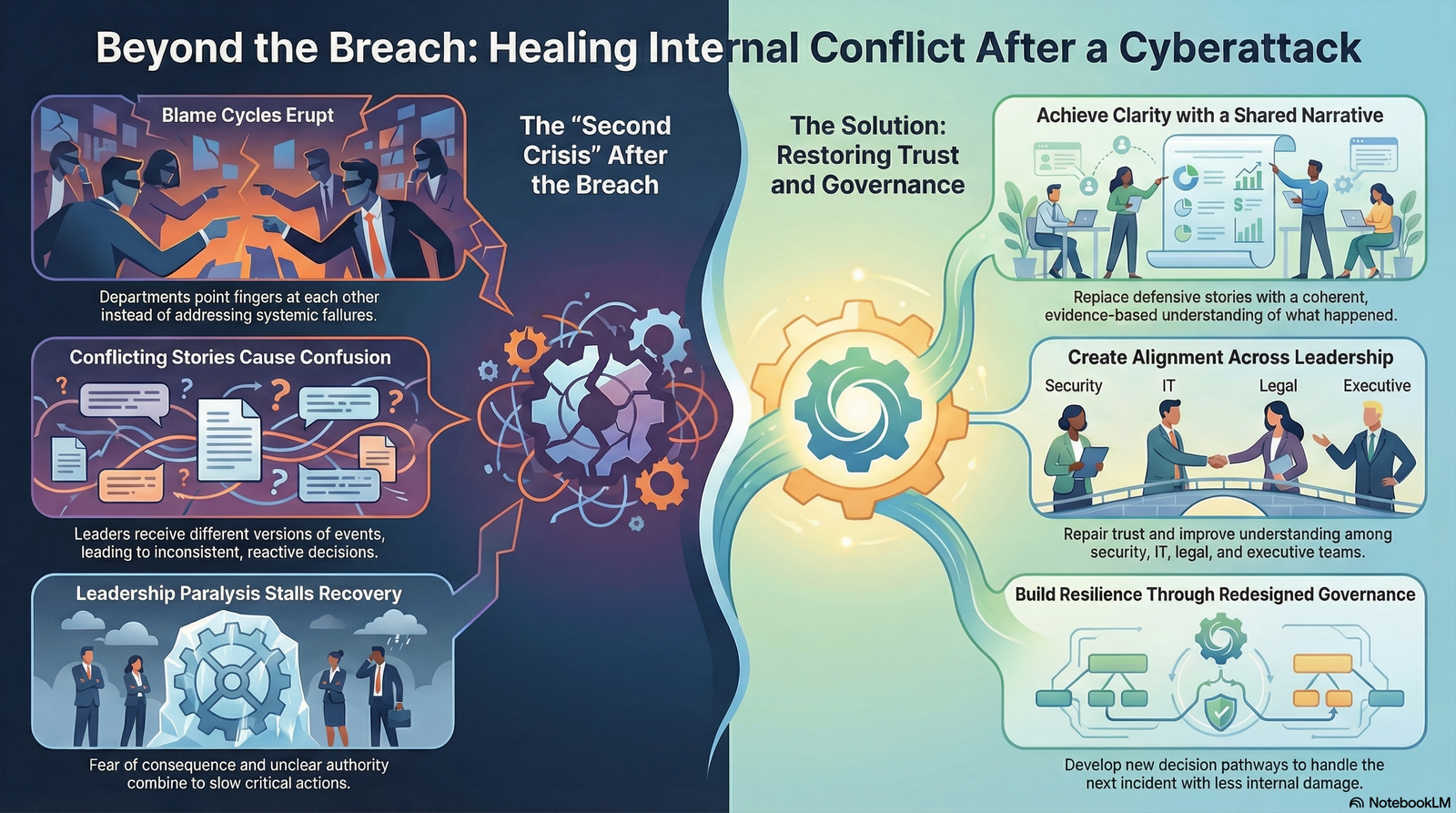
How to Read This Model
- Follow the path forward from the incident
- Identify where your organization is stuck
- Notice where traditional response stops
Simulation
A decision-driven walkthrough showing how post-incident conflict and governance breakdowns evolve after technical containment.
CPCS Post-Incident Simulation
Designed for executives, counsel, and security leaders. This is governance and decision simulation, not technical incident response training.
The organizational collapse after the breach
These are real, publicly documented incidents. The breach in each case was contained. What follows is the organizational breakdown CPCS Theory was built to address.
Services
CPCS Theory holds that post-incident organizational collapse follows a predictable sequence — from interpretive fracture through narrative divergence to governance failure and escalation loops. Each service below intervenes at a specific point in that sequence, and is designed to complement your existing incident response, forensics, and legal work.
Pricing reflects defined scope. Expanded or multi-entity engagements are quoted separately.
CPCS Application: Interpretive Fracture Reconstruction
A rapid assessment for organizations that contained the breach but are experiencing confusion, mistrust, or leadership strain. CPCS Theory identifies the Interpretive Fracture — the moment governance, judgment, and competing narratives converge — as the source of most post-incident organizational damage. We reconstruct that fracture point, then deliver a short-term stabilization plan.
Deliverables
CPCS Application: Authority Drift Containment
For executive teams under board, regulator, or insurer scrutiny with internal fracture risk. CPCS Theory defines Authority Drift as the informal migration of decision power away from formal governance roles — a predictable consequence of unresolved interpretive fracture that, left unchecked, produces decision degradation and blame cycles. We contain that drift, clarify decision authority, facilitate high-stakes alignment, and support narrative control compatible with legal privilege.
Deliverables
CPCS Application: Structural Conflict Architecture
For organizations where conflict keeps recurring because roles and decision rights are ambiguous. CPCS Theory treats recurring conflict not as a leadership problem but as a structural one — the architecture of authority was never designed to absorb the kind of pressure a cyber incident creates. We map real-world authority pathways, define escalation and accountability boundaries, modernize crisis governance policies, and deliver a staged implementation roadmap.
Deliverables
CPCS Application: Escalation Loop Elimination
Designs and implements a standing dispute resolution system for organizations moving beyond ad hoc crisis response. CPCS Theory identifies Escalation Loops — where unresolved conflict feeds back into the system, amplifying blame cycles and decision degradation — as the primary driver of long-term institutional damage after incidents. We establish detection signals, escalation triggers, and structured interfaces across technical, legal, risk, and executive domains, and deliver a durable operating playbook.
Deliverables
CPCS Application: Narrative Divergence Resolution
For organizations where competing interpretations of responsibility, failure, and intent are fueling ongoing disputes. CPCS Theory treats Narrative Divergence as a structural condition, not a communication failure — when leaders cannot agree on what happened, every subsequent decision becomes a proxy battle for the unresolved interpretation. We surface, examine, and realign organizational narratives to reduce polarization and enable forward-looking problem solving without compromising legal constraints.
Deliverables
CPCS Application: Conflict Literacy Development
Builds conflict literacy among boards and senior leaders — reframing cyber incidents as governance and dispute risks. CPCS Theory holds that most boards encounter escalation signals well before a conflict hardens, but lack the framework to recognize them as such. These briefings develop that recognition capacity, with emphasis on identifying early warning indicators before they become structural.
Deliverables
CPCS Application: Continuous Governance Monitoring
Continuous access to dispute resolution advisory — focused on conflict prevention, early intervention, and rapid stabilization. CPCS Theory recognizes that the conditions for post-incident collapse — authority ambiguity, narrative fragmentation, governance gaps — accumulate gradually and are far cheaper to address before an incident than after. Retainer clients gain ongoing monitoring of those conditions and immediate intervention capacity when incidents occur.
Deliverables
Products
Structured entry points grounded in CPCS Theory — for organizations and leaders who want diagnostic clarity or conflict literacy outside a full advisory engagement.
CPCS Foundations: Executive Master Class
An asynchronous briefing for senior leaders, general counsel, CISOs, and boards navigating post-incident environments where technical containment has occurred but governance and trust remain under strain. Delivered in short segments with executive-grade frameworks and diagnostic artifacts.
CPCS Diagnostic: Self-Guided Executive Version
A self-administered diagnostic for executives and boards to assess organizational fracture. Structured questionnaire with automated scoring and an interpretive report grounded in CPCS theory.
SurfacesCPCS Artifacts: Crisis-Ready Governance Templates
Deploy immediately after an incident.
CPCS Scenarios: Executive Walkthrough Library
Realistic post-incident scenarios analyzed through the CPCS lens. Structured executive reasoning exercises, not training.
CPCS Briefings
Short video and audio briefings on post-incident conflict, governance breakdowns, and executive decision making under cyber pressure.
View on YouTubeWhite Papers and Videos
Downloadable white papers and short video explainers translating CPCS concepts into practical governance actions.
CPCS White Paper Authoritative framework for post-incident governance and organizational conflict.Why Us
Most cybersecurity firms help contain the technical event. CPCS Advisory addresses what often follows: leadership strain, governance confusion, competing narratives, and the internal conflict that can outlast the breach itself.
What makes this different
We do not replace incident response, legal counsel, or forensics. We operate in the space those functions usually leave behind: the organizational damage that begins after technical containment.
- We focus on post-incident governance breakdown, not just technical remediation.
- We address interpretive fracture, narrative divergence, and authority drift before they harden into long-term institutional damage.
- We work at the intersection of cybersecurity, conflict resolution, governance, and executive decision support.
- We help organizations move from blame and paralysis toward structured recovery and accountable action.
This is not generic cyber consulting. It is a specialized advisory model built for the second crisis that begins after the breach.
Why Us Video
A short overview of why CPCS Advisory exists, what problem it solves, and why post-incident organizational conflict requires its own discipline.
About
Cyber Phronetic Conflict Advisory Group is led by Dr. Larry Snyder and operates at the intersection of cybersecurity, conflict resolution, and executive governance. We focus on post-incident environments where technical containment has occurred, but organizational stability, decision authority, and trust are breaking down.
Dr. Larry Snyder
Dr. Larry Snyder is the founder of Cyber Phronetic Conflict Advisory Group, a boutique consultancy focused on post-incident cyber conflict, governance failure, and executive decision breakdowns. His work sits at the intersection of cybersecurity, digital forensics, organizational governance, and conflict resolution.
He is a military police veteran, where early exposure to authority, accountability, and high-consequence decision-making shaped his understanding of how systems behave under stress.
Following military service, he worked as a fraud investigator and auditor within the banking and finance industry, examining financial misconduct, control failures, and institutional blind spots across complex organizational environments.
His professional experience spans incident response contexts, forensic analysis, governance review, and executive decision environments during periods of operational disruption. In parallel, he has spent more than twenty years teaching cybersecurity and digital forensics at the university level, with a sustained focus on how organizations interpret risk, responsibility, and evidence when events do not unfold as planned.
Across military, financial, academic, and cyber environments, one pattern remained consistent. Failures rarely originate from a single bad actor or missing control. They emerge when judgment, authority, narrative, and incentives collide. Dr. Snyder's work is dedicated to identifying those collision points and designing governance systems that can absorb disruption without cascading into paralysis, blame cycles, or institutional damage.
Cyber Phronetic Conflict Advisory Group was founded to address what traditional incident response, legal review, and compliance frameworks consistently leave behind: the human and organizational conflict that persists after containment.
Mission
Cyber Phronetic Conflict Advisory Group (CPCS Advisory) helps organizations manage and transform conflict that emerges after cyber incidents, governance failures, and high-stakes crises by applying formal conflict resolution theory, systems analysis, and governance design to restore decision clarity, legitimacy, and trust.
VisionVision
To establish post-incident conflict resolution as a recognized professional domain within cybersecurity incident response and organizational crisis management. We envision a future where conflict governance is understood as equally essential to incident response as technical remediation and legal compliance, where no organization considers an incident resolved until internal conflict dynamics are deliberately addressed.
Long-term, CPCS Advisory aims to transform how the cybersecurity and governance professions understand organizational failure. Rather than attributing post-incident breakdown to human error, communication failures, or leadership gaps, we seek to establish conflict resolution as a systematic, evidence-based practice that prevents institutional collapse under pressure. Success means a profession where conflict diagnosticians work alongside incident responders, governance realignment is a standard post-incident protocol, and organizational resilience is measured by capacity to transform conflict.
- Ethical conflict engagement
- Accountability and legitimacy
- Structured decision-making
- Systems over blame
- Professional discretion and trust
Voice & Presence
The ideas behind CPCS Advisory were visible publicly long before the practice existed. Dr. Snyder has been a recognized voice on cybersecurity risk, organizational vulnerability, and the human cost of cyber incidents since 2013 — years before post-incident conflict resolution emerged as a formal discipline.
The Dark Side of Cybercrime
Cybercrime costs the world trillions annually — but the real damage is measured in something else entirely. This TEDx talk introduced the argument that the human and organizational cost of cyber incidents is the dimension the field has consistently failed to address.
Program Director Keynote Presentation
As founding Program Director of the Bay Path University MS in Cybersecurity, Dr. Snyder opened the inaugural cybersecurity summit — establishing the program's framework for understanding organizational risk, not just technical threat. Presentation begins at 1:12:16.
From 2013 through 2018, Dr. Snyder was a recurring expert source for WWLP 22News (NBC Western Massachusetts) on cybersecurity risk, digital privacy, and organizational exposure — appearing in segments on digital footprints, unsecured IoT devices, public Wi-Fi vulnerabilities, banking security, and the regional workforce gap in cybersecurity. In 2017, he appeared as the featured guest on the 22News InFocus Sunday program. In 2018, a Massachusetts-wide media campaign coordinated by Paul Robbins Associates placed Dr. Snyder in on-air appearances across Western Massachusetts, Hartford, Albany, Worcester, and Boston markets for the launch of Bay Path's online MS in Cybersecurity — the same year Governor Charlie Baker visited Bay Path to announce state funding for the program.
Contact
All inquiries are handled confidentially. We focus on organizations where the stakes are significant and there is a genuine commitment to learning from incidents and improving governance.
Engagement expectations
We are selective about engagements to preserve depth, attention, and confidentiality. If there is a mutual fit, we typically begin with a short, privileged briefing to understand your situation and discuss next steps.